
India’s industrial landscape is becoming increasingly dependent on precision, especially across critical sectors such as pharmaceuticals, filtration, energy, and advanced manufacturing. Across these industries, operational performance is heavily tied to the way materials are understood and utilized, with testing under specific conditions determining results.
Where on, the one hand, the importance of material characterization is advancing, on the other, India’s dependence on overseas labs and imported instruments creates lags. Extended timelines, limited contextual interpretations, and high costs continue to limit adoption of necessary practices.
Bridging this gap is M19 Material Intelligence Lab. Based in Vadodara, the company operates across instrument manufacturing and lab services, offering complete capabilities in testing and analysis in relation to application. Combining measurement with interpretation, M19 enables industries to access material insights in a more direct and usable form, supporting decision-making across production, validation, and development processes with greater clarity.
Material Insights in Practice
“Materials science is no longer a back-end laboratory function. It has moved to the center of industrial strategy. Every critical sector, whether advanced manufacturing, pharmaceuticals, energy, or defense, now recognizes that performance begins at the material sub-micron level”, shares M19 Founder & CEO, Swasti Dey.
M19 works at the juncture where material testing directly informs production and validation decisions. The company has established its presence across 20+ key industries, including defence, space research, oil & gas, and personal hygiene. For pharmaceutical clients, the lab conducts filtration integrity testing under conditions that meet regulatory expectations while ensuring repeatability.
In membrane manufacturing, M19 enables detailed pore structure analysis that aligns with defined performance requirements. For hydrogen-related applications, permeability testing and leak tests is carried out to evaluate how materials will perform under extreme operational pressure. For technical textiles, various fabric performance parameters are performed as per international regulatory standards.
M19’s laboratory services are structured to deliver results that can be used immediately, whether for validation, compliance, or refinement. Reports are developed with application in mind, so teams are not left interpreting raw numbers in isolation.
As material requirements evolve, M19 continues to expand its scope of work, with its lab engaged with advanced filtration media and emerging composite structures, where testing parameters are more specific and performance margins tighter. In response, M19 adapts its testing approaches to suit these materials, ensuring that characterization remains relevant to real-world use rather than limited by standard methods. Uniquely, the company offers a lab membership model, enabling continuous access to testing infrastructure rather than just one-time services.
Developing Indigenous Testing Capability
M19 built its instrumentation capability in direct response to the challenges faced by its clients across industries. Instead of working around existing systems, the company chose to design and manufacture its instruments in-house, ensuring that each system aligns with actual testing requirements and operating conditions. The emphasis has remained consistent; measurement must be both precise and usable within application contexts.
Over time, this approach has evolved into a portfolio of more than 25+ characterization systems. PoreSense enables pore analysis across membranes and filtration media, while the FIA-100 supports filter integrity validation in regulated environments.
The MPA-100 is used for membrane performance testing, and the HP-500 addresses hydrogen permeability, particularly in emerging energy applications. Each system is developed with a defined use case, allowing for consistent performance under real-world conditions.
“M19 was born out of a deeply personal conviction: that India's industrial future could not be built on borrowed instruments and foreign data. Indian researchers and manufacturers depended on European and American systems, often facing months-long delays and receiving results without contextual interpretation”, adds Swasti Dey.
This perspective continues to shape how the company builds and validates its systems. Manufacturing follows structured quality frameworks, with the facility operating under ISO 9001:2015 certification, while alignment with ASTM, ISO and EN standards ensures that results remain usable across global regulatory environments. M19 extends this capability through its laboratory services, where characterization across pore size, permeability, filtration efficiency, and material integrity is supported by interpretation that remains closely tied to application.
The Brain Behind M19
M19’s team structure reflects how closely its work connects science with industrial use. Instrument design does not sit apart from laboratory work. Instead, it evolves alongside it, shaped by what the lab encounters across different materials and applications. Testing protocols at the company follow a similar path, developing with direct input from real-world use cases rather than remaining fixed.
M19’s laboratory services are structured to deliver results that can be used immediately, whether for validation, compliance, or refinement
Engineers focus on building systems that perform reliably under operating conditions, while laboratory scientists approach testing with a clear understanding of where and how results will be used. Interpretation is built into the process itself, ensuring that outputs remain relevant from the outset.
“M19's team of 35+ professionals spans multiple core functions: R&D, engineering, design, manufacturing, instrument assembly, physics, chemistry, material science, biotech, polymer science and technical after sales & support. What distinguishes the m19 team is not merely technical qualification, it is the rare intersection of scientific depth and industrial pragmatism”, states Swasti Dey.
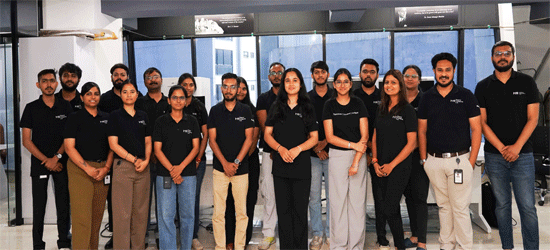
That intersection is visible in how work moves across the organization. Leadership experience rooted in international research environments brings scientific depth, while engineering and operations teams ensure that this depth translates into systems that hold up in practice. The team remains deliberately compact, allowing for closer alignment across functions and a clearer sense of ownership in how outcomes are delivered. At M19, failures are celebrated because they are the honest evidence of courage to experiment and push boundaries.
M19’s vision reflects a deliberate shift, from delivering individual testing solutions to building an integrated material intelligence platform
Expanding Capabilities Globally
M19’s trajectory is increasingly defined by how it is positioning itself beyond immediate testing requirements and into a broader role within material science ecosystems. The company is advancing its instrument portfolio with a focus on automation, digital integration, and connected data environments, ensuring that each system contributes to a larger, evolving framework rather than operating in isolation. Simultaneously, M19 is expanding its engagement across sectors such as pharmaceuticals, hydrogen energy, and advanced materials, where material performance is becoming more critical and more complex. This expansion is not only increasing the scope of its laboratory services, but also shaping how its technologies are designed to function across varied industrial and regulatory contexts.
“The future of M19 is best understood through the lens of our Vision 2030: to establish India's first full-spectrum material intelligence platform: one that integrates precision instrumentation, expert laboratory services, AI-driven analytics, and global knowledge networks into a single, seamless offering”, finally adds Swasti Dey.
M19’s vision reflects a deliberate shift, from delivering individual testing solutions to building an integrated material intelligence platform. Data generated across instruments and laboratory services is being structured to create continuity, enabling deeper analysis and more informed decision-making over time.
As it continues to build this ecosystem, M19’s role is beginning to extend beyond that of a service provider or instrument manufacturer. The company is shaping a framework where measurement, interpretation, and prediction converge, creating a system that supports not only how materials are tested, but how they are understood, developed, and applied across industries.





We use cookies to ensure you get the best experience on our website. Read more...


