Critical mineral recovery could gain a new research push after NITI Aayog and TEXMiN signed a Joint Statement of Intent to strengthen India’s critical minerals ecosystem.
The collaboration is intended to advance indigenous technology, research and resilient mineral value chains.
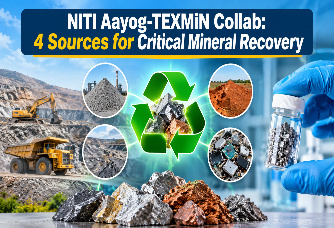
At the National Symposium on Critical Minerals and Rare Earths, NITI Aayog Member Gobardhan Das highlighted the potential of recovering valuable materials from coal fly ash, red mud, mine tailings and electronic waste.
The focus now shifts to whether these secondary resources can support commercially viable processing technologies and provide additional inputs for India’s manufacturing industries.
India's industrial waste streams could offer an additional resource base for critical mineral recovery as the country seeks to strengthen domestic processing capabilities.
The opportunity extends beyond waste management. Recovering critical minerals from industrial waste could help supplement primary mineral supplies and create additional sources of industrial raw materials.
Depending on the composition and recovery economics, these materials could support downstream applications in electronics, renewable energy, electric mobility and advanced manufacturing.
A relevant example is the work undertaken by National Aluminium Company Limited (NALCO). In August 2026, the company inaugurated an indigenous pilot plant at its Research and Technology Centre in Bhubaneswar to process bituminous coal fly ash.
Designed by CSIR-IMMT and KIIT with NALCO, the jointly patented process enables the recovery of alumina, calcium silicate for ceramic applications and quartz residue with potential use in glassmaking.
These developments illustrate how critical mineral recovery technology can convert industrial residues into potential sources of value-added materials.
Also Read: How Silicon Anodes Could Reshape India's EV Battery Market
The NITI Aayog-TEXMiN collaboration focuses on four areas that include:
For critical mineral recovery to become commercially viable, research institutions and industrial companies will need to address challenges involving mineral concentration, extraction efficiency, separation processes, product purity and processing costs.
Electronic waste presents another opportunity through mineral recovery from discarded electronics, while mine tailings could provide additional feedstock for reprocessing.
Indigenous mineral processing technology could help reduce dependence on imported processing capabilities while creating opportunities for Indian engineering, equipment and technology developers.
The broader opportunity lies in connecting sustainable mineral processing in India with the country's growing demand for advanced industrial materials.
Rare earth elements are important inputs for permanent magnets, electric mobility, renewable energy equipment, electronics and defense applications.
NALCO's fly ash pilot provides an existing example of how research partnerships can explore the recovery of materials with potential downstream applications.
The NITI Aayog-TEXMiN partnership could provide a framework for connecting research institutions, technology developers, policymakers and industrial companies. India's critical mineral recovery efforts will ultimately require more than identifying secondary resources.
The partnership therefore places attention on an important part of India's critical minerals strategy: building domestic capabilities to recover, process and convert available resources into manufacturing-ready materials.




We use cookies to ensure you get the best experience on our website. Read more...