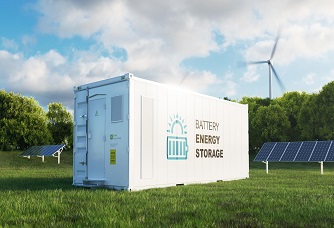
India’s BESS capacity is projected to grow rapidly as the country expands renewable energy and strengthens grid reliability.
A recent Nuvama report forecasts a 91 percent compound annual growth rate (CAGR) between FY26 and FY32E. Cumulative battery energy storage system (BESS) capacity could rise from 6.3 GWh to 302 GWh during this period.
Annual additions are expected to increase from 5.7 GWh in FY26 to 56 GWh by FY32E. The Central Electricity Authority (CEA) estimates that India will require 236 GWh of BESS capacity by FY32 and 1,840 GWh by 2047.
However, the sector's expansion will depend on domestic manufacturing, falling battery costs, and policy support. Nuvama noted that imports currently meet 89 percent of requirements, creating an opportunity for local manufacturers to expand production.
Lithium-ion batteries account for 98 percent of the BESS market. However, sodium-ion technology and the China+1 strategy could create new opportunities for Indian manufacturers. A framework similar to the Approved List of Models and Manufacturers (ALMM) could also encourage domestic production.
Nuvama's analysis highlights different profit margins across battery manufacturing segments. Commercial, industrial, and retail applications offer spreads of USD 18–23 per kilowatt-hour (kWh), translating into EBITDA margins of 17–20 percent. The utility segment generates a lower spread of USD 8 per kWh and an EBITDA margin of 9 percent.
Despite these differences, the report estimates a one-to-two-year payback period for cell-to-pack manufacturing, including in the utility segment.
Also Read: How Battery Economics Will Shape Electric Two-Wheeler Profit Margins
Key factors shaping the opportunity include:
An integrated BESS facility offers a more modest estimated internal rate of return (IRR) of 12 percent. However, the report highlights capital expenditure of USD 80 million per GWh, PLI support of Rs 181 billion for 50 GWh, and competitive labor costs as potential advantages. Cell-to-pack manufacturing offers a higher estimated IRR of 31 percent.
The expansion could also create new revenue opportunities for listed solar and battery storage companies. Nuvama estimates that BESS integration could contribute 17–60 percent of companies' projected FY28 revenue.
Premier presents a potential opportunity worth Rs 103 billion, equivalent to 60 percent of its projected FY28 revenue. Vikram could see a 54 percent revenue uplift from BESS, according to the report. However, the earnings contribution remains limited for most listed solar and BESS companies despite their early investments and expansion plans.
Nuvama also noted that solar and BESS stocks trade at 17 times estimated FY27 earnings per share (EPS). This represents a 77 percent discount to battery chemicals companies and a 64 percent discount to battery independent power producer (IPP) peers.
The report believes rising capacity and stronger BESS capacity contributions could support earnings upgrades and valuation re-rating. Whether these opportunities translate into sustained growth will depend on execution, policy support, and the pace of domestic manufacturing expansion.
.jpg "Saksham Enterprises: Optimizing Mission- Critical HVAC Infrastructure For The High Precision Sector")

.jpg "JDS Group of Companies: Innovating Smart Solutions For Modern Power Transmission & Distribution Infrastructure")




We use cookies to ensure you get the best experience on our website. Read more...