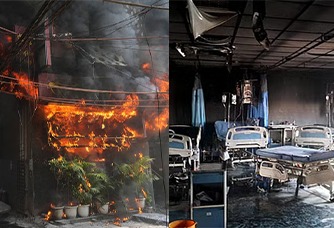
In the span of just a few days, fire incidents that occurred in India, from a hotel in Delhi’s Malviya Nagar to a hospital in Bihar, have once again exposed a recurring vulnerability in the country’s fire safety systems.
While each incident is often treated as an isolated tragedy, the pattern they both reveal is far more concerning. These are not one-off failures; they are indicators of a deeper, systemic gap in how commercial spaces are designed, used, and safeguarded.
India’s fire safety challenge today is not rooted in the absence of regulations. On paper, the country has a well-defined framework. The National Building Code (NBC) 2016 lays down comprehensive fire safety norms, while state fire departments mandate No Objection Certificates (NOCs) for commercial establishments.
Yet, despite these provisions, fire incidents continue to claim lives with alarming regularity.
According to the National Crime Records Bureau (NCRB), India records over 7,000 fire-related deaths annually, with a significant proportion occurring in residential and commercial structures.
Data from the NCRB’s Accidental Deaths & Suicides in India reports over the past decade indicates that fire accidents consistently rank among the leading causes of accidental deaths.
What is more concerning is that many of these fatalities occur in environments where basic fire safety systems either failed or were absent altogether.
The recent incidents in Delhi and Bihar are stark reminders of this gap. In both cases, early reports point toward familiar issues and restricted exits, high occupancy levels, and delayed response mechanisms.
These are not unpredictable risks; they are known vulnerabilities that have surfaced repeatedly in past tragedies, including the Mundka factory fire in 2022 and the AMRI hospital fire in Kolkata in 2011.
Recent developments further reinforce the scale and evolving nature of this risk. On June 11, 2026, in Delhi’s Mayapuri, a massive fire engulfed an industrial unit, leading to the partial collapse of the first and second floors of a factory building. The structure, comprising a basement, ground floor, and two upper levels, suffered significant damage as flames spread rapidly across steel-cutting and packing material operations.
Around 18 fire tenders were deployed, and while no casualties were reported, the building has been rendered structurally unsafe, highlighting how fire intensity can quickly escalate into infrastructural failure.
In another critical incident reported on June 24, 2026, a fire at a major data center operated by Tata Communications and ST Telemedia in Delhi caused extensive damage, making recovery of over two decades of client data extremely challenging. Companies such as Matrix Cellular and R2 Net have faced significant losses, including operational, billing, and commercial data, while the incident also triggered network disruptions impacting cloud services like Google Cloud.
The event has had far-reaching implications on business continuity, with affected firms reporting financial and operational setbacks. Tata unit Novamesh is currently assessing the damage, conducting a detailed technical root cause analysis, and has indicated that full restoration may take several weeks, classifying the situation as a force majeure event. The scale of the disruption underscores how fire risks today extend beyond physical safety to digital infrastructure resilience and long-term data security.
The issue lies a critical disconnect between regulatory compliance and operational reality. Buildings may receive fire clearances at the time of construction or licensing, but their usage often evolves far beyond what was originally approved.
A structure designed for limited occupancy may eventually function as a high-density commercial space. A small clinic may expand into a full-fledged hospital. A residential building may be repurposed into a hotel or a mixed-use establishment.
In such scenarios, fire safety systems whether alarms, sprinklers, or evacuation routes are rarely upgraded to match the new level of risk. Compliance becomes a one-time checkbox exercise, rather than an ongoing responsibility aligned with real-world usage.
This issue is further amplified by the rapid growth of India’s commercial real estate sector. Contributing approximately 7–9 percent to the country’s GDP, the construction and real estate industry has been expanding steadily, driven by urbanization, rising consumption, and infrastructure development. Across metropolitan cities and emerging tier-2 hubs, there has been a visible surge in office complexes, hotels, retail spaces, and mixed-use developments.
However, this expansion is not just increasing physical infrastructure; it is intensifying how these spaces are used. Commercial establishments today operate with higher occupancy densities, longer working hours, and significantly greater electrical and mechanical loads. In many cases, older buildings are being retrofitted or extended to meet growing demand, often without a proportional upgrade in fire safety systems.
The result is a silent but expanding risk layer. Fire safety mechanisms that were once adequate are now misaligned with current usage conditions. Evacuation routes become insufficient, detection systems outdated, and suppression mechanisms unreliable under stress.
Beyond urban commercial hubs, the risk extends into India’s industrial and manufacturing corridors. As the country pushes for economic growth through initiatives like Make in India and the expansion of MSMEs, industrial clusters are witnessing increased activity.
These environments inherently carry higher fire risks due to the presence of flammable materials, heavy machinery, and continuous operations. Yet, compliance and enforcement in smaller industrial units often remain inconsistent.
Addressing this challenge requires a fundamental shift in approach. Fire safety can no longer be treated as a static compliance requirement tied to building approval. Instead, it must evolve into a dynamic, usage-linked system.
Fire safety audits need to move from periodic inspections to continuous monitoring mechanisms. With advancements in smart building technologies, real-time system checks and alerts are increasingly feasible.
At the same time, certifications must reflect actual occupancy and usage patterns, not just original design plans. Any change in building function should trigger a reassessment of safety systems.
Stronger enforcement and clearer accountability at the local level will also be critical, as implementation continues to vary widely across regions.
Fire safety systems undergoing a quiet but significant transformation, driven by digital integration and predictive capabilities.
One of the most important advancements is the integration of IoT (Internet of Things) in fire detection and response systems. Modern buildings are increasingly deploying networked fire sensors that can continuously monitor temperature variations, smoke density, and electrical anomalies in real time. These systems are capable of triggering automated alerts, activating suppression mechanisms, and even notifying emergency services without human intervention.
Another notable factor is AI-enabled fire detection, especially through video analytics. Cameras integrated with AI models can now identify early signs of fire like unusual smoke patterns or heat signatures, far earlier than conventional detectors.
Smart fire panels are also evolving into centralized command systems, integrating HVAC shutdowns, elevator controls, and access systems during emergencies. In high-end commercial spaces, this creates a coordinated response rather than fragmented reactions.
Globally, there is also movement toward digital twins of buildings, where fire scenarios can be simulated in advance to assess evacuation efficiency and system readiness. While still nascent in India, such technologies are beginning to find adoption in premium developments.
The shift, therefore, is clear: from reactive fire response to predictive risk management.
Large commercial developers such as DLF, Lodha Group, and Prestige Group have begun integrating automated sprinkler systems, intelligent fire alarms, and central monitoring systems across their premium commercial projects.
In IT parks and SEZs, fire safety is often embedded into the building management system (BMS), ensuring real-time monitoring across floors.
In the industrial segment, companies in sectors such as oil & gas, automotive, and chemicals like Reliance Industries and Tata Group companies deploy advanced fire suppression systems, including gas-based suppression (FM-200, NOVEC 1230) in sensitive environments such as data centers and control rooms.
What differentiates these players is not just installation, but redundancy and testing protocols. Systems are periodically stress-tested, and emergency response drills are institutionalized.
However, this level of integration is largely limited to Grade A commercial assets and large enterprises. A significant portion of mid-sized commercial buildings and MSMEs still rely on basic or outdated systems, highlighting a wide gap in adoption across the ecosystem.
One of the persistent debates in India’s fire safety landscape is the trade-off between cost and quality.
Indian fire safety equipment manufacturers have made significant progress in recent years, offering cost-effective solutions that comply with Bureau of Indian Standards (BIS) certifications. For many commercial establishments, especially in price-sensitive markets, these systems provide an accessible entry point into compliance.
However, when compared to leading Western manufacturers, differences emerge in technology sophistication, system integration, and long-term reliability. International systems often come with advanced features such as predictive diagnostics, remote monitoring, and higher durability standards, particularly in complex or high-risk environments.
The cost differential can range anywhere between 20 to 50 percent higher for imported or globally benchmarked systems. As a result, many developers, especially in non-metro regions, opt for lower-cost installations that meet minimum compliance requirements but may not deliver optimal performance under stress.
This creates a critical concern: fire safety decisions are often cost-driven rather than risk-driven.
India’s regulatory framework for fire safety is robust in design but uneven in enforcement. The National Building Code (NBC) 2016 provides detailed guidelines on fire prevention, life safety, and fire protection systems. In addition, state-level fire departments enforce compliance through mandatory NOCs.
However, in contrast to Western markets such as the US and parts of Europe, India lacks uniform enforcement and continuous compliance mechanisms. In countries like the United States, standards set by the National Fire Protection Association (NFPA) require not just installation, but regular inspection, testing, and certification cycles, often audited by independent bodies.
Similarly, in the UK, the Regulatory Reform (Fire Safety) Order places direct accountability on building owners and operators to conduct ongoing risk assessments.
In India, enforcement tends to be front-loaded, focused on approvals during construction or licensing rather than lifecycle-based monitoring. Post-approval audits are inconsistent, and accountability mechanisms remain fragmented across jurisdictions.
This creates a structural gap where buildings may be compliant at inception but drift into risk over time.
India’s commercial growth story is one of ambition and scale. But as cities expand and buildings become more complex, safety systems must keep pace.
The recent fire incidents are not just warnings, they are alarms of a structural imbalance that needs urgent correction and focus.
Until fire safety becomes integral to how commercial spaces operate, not just how they are approved, the risk will remain embedded within India’s growth story.
.jpg "Precise Fasteners: Committed To Fulfilling Client Expectations, Every Time!")




We use cookies to ensure you get the best experience on our website. Read more...