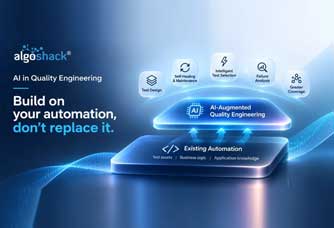
As AI capabilities mature across the software development lifecycle, enterprise Quality Engineering teams face a familiar pressure: adopt the new approach, or risk falling behind. For many organisations, that pressure is arriving in the form of a choice: replace existing test automation with AI-driven alternatives, or risk missing the productivity gains competitors are pursuing.
That framing is wrong, and acting on it is expensive.
The enterprises that will get the most from AI in Quality Engineering are not the ones that discard what they have built. They are the ones that identify precisely where existing automation is struggling and introduce intelligence at those specific points. The distinction matters because it changes both the economics and the timeline of AI adoption in testing.
What Existing Automation Actually Represents
Most enterprise Quality Engineering environments are not starting from a blank page. Organisations have invested years in automation frameworks, regression suites, CI/CD pipeline integrations, test data, reporting systems and the accumulated application knowledge that sits inside those assets.
This is worth taking seriously. Automation scripts are not just code, they are a record of how an application is expected to behave, what business rules matter, which integration points are critical and where historical failures have occurred. That knowledge does not transfer automatically to a new platform.
Replacing existing automation entirely means recreating coverage, validating new frameworks, rebuilding integrations and retraining engineering teams. In regulated or process-intensive environments, it also means revisiting established traceability and governance practices. The disruption cost is real, and it often arrives at the same time organisations are trying to move faster, not slower.
The starting point for AI-Augmented Autonomous Quality Engineering is therefore not replacement. It is an honest assessment of where existing automation is creating friction, and where intelligence can reduce it.
Where Traditional Automation Begins to Struggle
Traditional automation remains essential for repeatable validation. Its limitations emerge not from the concept but from what enterprise applications have become: faster-changing, more distributed, more integrated and increasingly shaped by AI components whose behaviour does not follow deterministic patterns.
As applications grow and release cycles accelerate, Quality Engineering teams find themselves spending substantial time on activities that do not require their expertise. Updating scripts after interface changes. Investigating test failures caused by modified element identifiers rather than genuine defects. Identifying which tests are relevant to a particular change. Analysing coverage gaps across an expanding regression suite. Running thousands of tests after every build regardless of what actually changed.
The challenge most organisations face is not that they chose automation poorly, it is that they have reached the ceiling of what script-based automation alone can sustain. The maintenance burden grows faster than the team’s capacity to absorb it. Feedback cycles lengthen at exactly the moment development speed is increasing.
This is where AI-Augmented Autonomous Quality Engineering changes the equation, not by removing automation, but by introducing intelligence around it.
Where AI Extends Rather Than Replaces
The most practical applications of AI in Quality Engineering address the activities that consume engineering time without too much engineering judgement.
Test design is one. AI-assisted approaches can analyse requirements, identify relevant scenarios and generate structured test cases, reducing the preparation effort for new features while surfacing scenarios that might otherwise receive limited coverage. The value is not volume, it is relevance. AI generation that lacks application context simply adds to the maintenance burden rather than reducing it.
Automation maintenance is another. Application changes frequently require engineers to update scripts, locating affected tests, understanding what broke and determining whether the failure reflects a genuine defect or a changed interface. AI-assisted self-healing and maintenance capabilities can identify affected automation and suggest or apply appropriate changes. The important caveat is that self-healing must remain observable. Teams need to understand what changed and confirm that updated scripts still validate the intended business behaviour. Human oversight is not optional here, particularly for critical or regulated workflows.
Intelligent test selection follows the same principle. Rather than executing the complete regression suite after every build, AI can analyse what has changed and surface the tests most relevant to that change, making feedback cycles faster without reducing the coverage available at major release milestones.
Integration Is the Harder Problem
Enterprise Quality Engineering environments are rarely built around a single testing technology. Different teams may use different frameworks. Testing environments include CI/CD pipelines, requirement management systems, defect trackers, reporting platforms and release governance tools that have been integrated over years.
Introducing AI without considering this ecosystem does not simplify the environment, it adds another layer to it. Organisations risk duplicated test assets, fragmented reporting, disconnected workflows and reduced traceability, alongside the governance requirements that come with any new platform. The result can be more complexity at the point where teams were hoping for less.
The more effective question is not “which AI testing platform should we adopt?” It is “where is our current Quality Engineering process creating the greatest friction, and what would reducing that friction actually require?” For some organisations, the answer is test creation. For others, it is automation maintenance, regression cycle length, coverage visibility or failure analysis. Starting from the friction point makes AI adoption concrete rather than speculative.
Human Governance Becomes More, Not Less, Important
Greater autonomy in testing does not reduce the need for engineering judgement, it changes where that judgement is applied.
AI-generated tests, automated maintenance changes and intelligent execution decisions all require appropriate governance, particularly when software supports critical business or regulated processes. Quality Engineering teams need to understand what an AI system changed, why a particular test was selected and whether the resulting validation still reflects the intended requirement.
Traceability and observability become the foundation of trustworthy autonomous Quality Engineering. The future of testing is not one in which humans disappear from the process. It is one in which engineering teams move from performing repetitive testing activities to governing increasingly intelligent testing systems, reviewing higher-value decisions, investigating complex scenarios and maintaining accountability for release quality.
How algoQA Approaches This Transition
algoQA, AlgoShack’s AI-Augmented Autonomous Quality Engineering platform, is designed around the principle that existing automation is an asset to build on, not a constraint to work around.
Two of algoQA’s AI agents are directly relevant to organisations navigating this transition. Nomad, the Test Migration agent, supports the movement of existing automation assets into algoQA’s environment, preserving the coverage, application knowledge and business logic embedded in established test suites rather than requiring teams to recreate it. Koda, the Test Scripting agent, generates executable automation scripts from natural-language inputs and recorded scenarios, working alongside existing frameworks rather than requiring their replacement.
Together with Swift (Test Optimisation) and Sherlock (Failure Analysis), these agents introduce intelligence at specific points in the Quality Engineering lifecycle where manual effort is highest, while the platform’s application profiling capability maintains the context that makes AI-assisted decisions reliable rather than generic.
algoQA also supports incremental adoption. Teams can begin with the area where the business case is clearest, test design, automation maintenance or regression optimisation, and expand as confidence and governance practices mature. This makes the transition manageable without requiring a wholesale change to the testing environment.
The Right Way to Think About AI in Testing
The next phase of enterprise Quality Engineering will not be defined by which organisations replaced their automation fastest. It will be defined by which ones made the automation they already depend on more intelligent, more adaptive and more aligned with how their applications actually change.
Existing automation carries years of application knowledge. The opportunity AI creates is not to discard that knowledge but to surround it with intelligence that reduces the effort required to maintain it, act on it and trust it at release time.
For enterprises evaluating AI-Augmented Autonomous Quality Engineering, the most important question is not whether to adopt. It is where to start, and that answer is almost always found in the specific friction points your engineering teams are absorbing today, not in a platform’s feature list.
About AlgoShack Technologies
AlgoShack Technologies is a Bengaluru-based enterprise technology company and the developer of algoQA, an AI-Augmented Autonomous Quality Engineering platform. algoQA supports intelligent test design, automated test generation, execution, maintenance and test management across web, mobile, desktop and API applications. AlgoShack Technologies serves enterprise clients across healthcare, banking, retail and technology sectors. For more information, visit www.algoshack.com.






We use cookies to ensure you get the best experience on our website. Read more...