A stainless steel sheet may be dimensionally acceptable yet still show inconsistent grinding marks, shallow scratches or visible bands after finishing. On architectural panels and appliance surfaces, these differences become more obvious when sheets are installed side by side.
A non-woven abrasive roller can refine the surface, but its result depends on the incoming material and the conditions at the contact zone. Specifying only an abrasive grade rarely provides enough information to reproduce a finish.
Begin With the Incoming Surface
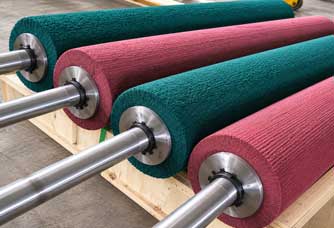
Non-woven abrasive material contains abrasive particles bonded within a flexible, three-dimensional fibre web. It is suited to surface conditioning: blending light marks, refining an earlier grinding pattern and producing a controlled satin or brushed appearance.
It has limited stock-removal capacity compared with a grinding belt or wheel. If a scratch is deeper than the material the finishing pass can reasonably remove, the roller may soften its edges while leaving it visible. Heavy weld reinforcement, deep handling damage and strongly adherent scale therefore need an appropriate preparation stage.
The starting finish must be recorded during a trial. Two sheets of the same stainless steel grade can respond differently if one has a uniform pre-ground surface and the other has mixed scratches or residual mill marks.
Choose the Contact Structure
Roller construction affects how the abrasive meets the sheet. A convolute roller presents a relatively continuous working face. Radial flaps bend independently and can accommodate modest changes in surface geometry. A denser unitized construction resists deformation, while an interleaved design adds coated abrasive where more cutting action is needed.
These differences matter particularly on wide sheets. A roller must make sufficiently uniform contact across its working width; otherwise, changes in pressure or wear can create longitudinal bands. Construction should be chosen alongside the machine’s support and loading arrangement, rather than from the desired finish name alone.
Abrasive mineral, grade and web density are separate decisions. Aluminum oxide and silicon carbide are both used in non-woven products, but neither guarantees a particular stainless steel finish. A coarser grade generally acts more aggressively; a denser web generally produces firmer contact. The resulting texture still depends on the complete roller and its operating conditions.
Set Speed, Feed and Contact Together
Roller speed should be evaluated as surface speed, not rpm alone. For a roller with outside diameter D in metres rotating at n rpm, surface speed is:
v = πDn ÷ 60
For example, a 300 mm diameter roller at 1,000 rpm has a surface speed of approximately 15.7 m/s. This is a calculation example, not a recommended operating speed. The approved limit must be confirmed for the complete roller assembly, including its core, shaft and construction.
Sheet feed speed determines how long a given area is exposed to the abrasive. Contact setting—whether controlled by roller position, gap or applied load—determines how much the web compresses against the sheet. Changing one variable can alter the effect of the others. Excessive contact may accelerate wear or produce an unwanted texture; insufficient contact may leave the earlier grinding pattern largely unchanged.
Osborn’s technical information on non-woven abrasive rolls likewise identifies roller diameter, pressure, cutting speed, feed speed and density as factors affecting surface roughness. Its product settings should not be treated as universal settings for a different roller or machine.
Wet finishing adds another specification: the abrasive bond, core and complete assembly must be suitable for the process fluid. Tooling used on carbon steel should also be kept separate from stainless steel finishing media to reduce the risk of transferred iron particles and later staining.
“Satin” or “brushed” describes an appearance, not a complete acceptance specification. An approved sample establishes the intended colour, reflectivity and direction of the marks. Surface roughness measurements add a quantitative check, but a single Ra value cannot capture visible streaks or differences in the directional pattern.
A useful production trial uses representative stainless steel with the intended incoming finish. Record the roller construction and grade, actual outside diameter, rpm, sheet feed speed, contact setting, number of passes and wet or dry conditions. Change one setting at a time. Inspect the result across the full sheet width and repeat the check after a practical run, when the roller is no longer new.
For a replacement non-woven abrasive roller, provide the machine drawing as well as the finish sample. Working width, core and shaft dimensions, mounting details, rotational direction and approved operating speed all need confirmation. A roller that fits the machine but changes the contact pattern can still change the finished sheet.
The aim is a repeatable surface over the required width and production run. That result comes from specifying the roller and the finishing conditions together.






We use cookies to ensure you get the best experience on our website. Read more...