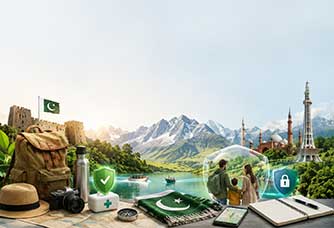
From the Karakoram Highway's mountain switchbacks to the crowded bazaars of Lahore, Pakistan packs an unusual range of experiences into one country. It's also a place where a little preparation goes a long way, since infrastructure, customs, and logistics differ significantly from what many travelers are used to. Here's what to know before you go.
Pakistan uses an online visa system that's genuinely more straightforward than it used to be, but it still requires planning. Most nationalities can apply through the government's e-visa portal, which typically takes 7-10 business days to process, though delays happen during busy seasons. Have your hotel bookings, a rough itinerary, and a passport with at least six months of validity ready before you start the application.
Some regions near the Afghan and Indian borders require additional permits, particularly if you're heading toward Chitral, parts of Gilgit-Baltistan, or areas close to Kashmir. Check current requirements a few weeks before departure, since restricted zones shift based on security assessments. Local tour operators can usually help arrange these permits faster than doing it independently.
Pakistan's geography ranges from sea-level coastline in Karachi to peaks over 8,000 meters in the north, and the climate shifts just as dramatically. Summer in Lahore or Islamabad can push past 40°C, while the same season in Hunza or Skardu stays comfortably cool, often dropping below 10°C at night. If your trip spans both lowland cities and mountain valleys, pack layers rather than committing to one climate.
Winter travel in the north requires serious cold-weather gear, since many mountain roads become difficult to access and temperatures regularly fall below freezing. A lightweight down jacket, thermal layers, and sturdy waterproof boots are worth the suitcase space if you're planning any high-altitude travel between November and March.
Pakistan is a conservative Muslim-majority country, and clothing choices matter more here than in many other travel destinations. For women, loose-fitting clothing that covers the shoulders, arms, and legs is standard, and a scarf is useful for visiting mosques or more rural areas. Men should avoid shorts in most public settings outside tourist-heavy resort areas.
Islamabad and Lahore's upscale neighborhoods are more relaxed than smaller towns in Khyber Pakhtunkhwa or rural Punjab, but erring conservative everywhere avoids unwanted attention and shows respect for local norms. Bringing a couple of loose cotton shirts and long trousers solves most of this without sacrificing comfort in the heat.
English is widely spoken in cities, business settings, and among educated younger Pakistanis, but a handful of Urdu phrases open doors in smaller towns and markets. "Shukriya" (thank you), "Kitna paisa?" (how much does this cost?), and "Meherbani" (please) go a long way with vendors and drivers. People generally respond warmly to visitors making even a small effort with the language.
In more remote areas like Hunza or Baltistan, local languages such as Burushaski or Balti are common, but Urdu still functions as a reliable bridge language nearly everywhere.
Pakistan's security situation has improved substantially over the past decade, and areas like Hunza, Skardu, Lahore, and Islamabad see steady tourist traffic without major incident. That said, checking current travel advisories from your home country's foreign ministry before finalizing plans is a smart habit, particularly for border regions or areas in Balochistan and parts of Khyber Pakhtunkhwa.
Working with an established local operator for Pakistan tours is one of the more reliable ways to handle logistics smoothly, since these companies understand which routes are currently accessible, which permits are needed, and how to adjust plans if road conditions or checkpoints change unexpectedly. They also tend to have relationships with local guides who know the terrain and can flag issues before they become problems.
Credit card acceptance in Pakistan remains limited outside major hotels, airlines, and upscale restaurants in Karachi, Lahore, and Islamabad. ATMs are available in most cities but can be scarce or unreliable in mountain regions, so carrying enough Pakistani rupees for several days is a practical habit, especially when traveling north. Currency exchange counters at airports offer fair rates, though local banks sometimes beat them slightly.
Keep smaller denominations on hand for markets, tips, and transportation, since vendors and rickshaw drivers often can't break large notes.
Pakistan offers striking photo opportunities, from the Faisal Mosque's modern architecture to terraced fields in Hunza Valley, but certain subjects require caution. Military installations, checkpoints, airports, and government buildings are off-limits for photography, and ignoring this can lead to real trouble with authorities. Always ask before photographing individuals, particularly women, since cultural sensitivities around personal photos run stronger here than in many other countries.
Northern Pakistan's mountain regions are best visited between May and September, when roads are clear and valleys are green, while the Karakoram Highway can become impassable in heavy winter snow. Lowland cities like Lahore and Multan are far more pleasant between October and March, avoiding the brutal summer heat that settles over Punjab and Sindh. If your itinerary covers both regions, sequencing matters: consider hitting the mountains first in early autumn before winter closures, then moving south as temperatures cool.
Pakistan rewards travelers who do their homework beforehand, since the payoff, whether it's a quiet valley in Hunza or a plate of fresh biryani in Karachi, tends to be more memorable when the logistics aren't fighting you the whole way.
.jpg "Industrial Solutions Providers")
.jpg "Industrial Packers: Engineering Industrial Packaging for India's Manufacturing Future")



We use cookies to ensure you get the best experience on our website. Read more...