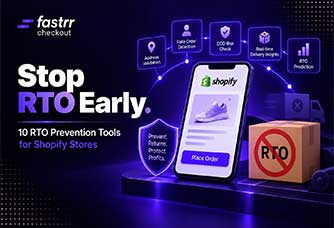
Return-to-origin (RTO) is one of the biggest profitability challenges for Indian ecommerce businesses, particularly those with a high share of Cash on Delivery (COD) orders. Incorrect addresses, low purchase intent, failed delivery attempts, unavailable customers and excessive dependence on COD can all contribute to an order becoming an RTO.
This has led to a growing category of RTO prevention tools for Shopify stores. The most effective solutions intervene before an order reaches fulfilment through risk prediction, address intelligence, COD controls, prepaid incentives and delivery communication.
However, not every tool approaches RTO the same way. Some focus on preventing risky orders at checkout, while others concentrate on post-order delivery and NDR management.
RTO Prevention vs RTO Management: What's the Difference?
RTO prevention focuses on reducing the likelihood of an order becoming an RTO before or during order placement. This can include RTO prediction, address verification, COD controls and prepaid conversion.
RTO management generally focuses on orders that have already entered fulfilment, using tools such as NDR automation, customer communication and delivery reattempts.
Both approaches are useful, but Shopify brands should identify where most of their RTOs originate before choosing a solution.
How We Evaluated These RTO Prevention Tools
The tools in this list were considered based on their ability to address common RTO drivers, including:
With these factors in mind, here are the 10 RTO prevention options Shopify merchants in India can consider.
1. fastrr Checkout - Best Overall for RTO Prevention
fastrr Checkout takes a multi-layered approach to RTO prevention by addressing risk directly within the checkout journey. It combines AI-powered RTO prediction, address intelligence, COD controls, partial COD and prepaid incentives to help merchants identify and reduce risky orders before they enter fulfilment.
Its checkout-level approach is particularly relevant for Shopify brands because merchants can intervene while purchase intent is still fresh. Risk-based COD controls can help restrict COD for potentially risky orders, while prepaid nudges and incentives can encourage customers towards online payments.
Beyond RTO prevention, fastrr helps optimise checkout journey, from reducing friction and improving payment success to personalising the buying experience and helping customers complete their purchases.
fastrr also combines RTO prevention with checkout optimisation, allowing brands to work on order quality and conversion together rather than treating them as separate problems.
2. GoKwik - Best for COD Risk Management
GoKwik's RTO suite uses shopper and network data to assess COD risk before payment. Its RTO API considers multiple signals, including address intelligence, purchase intent and historical behaviour, while its Shopify solution supports dynamic COD controls.
It is a strong option for brands where COD contributes significantly to RTO. Its focus on risk-based COD interventions makes it particularly relevant for merchants looking to reduce risky COD orders.
3. Shopflo - Best for Checkout-Level RTO Controls
Shopflo approaches RTO reduction through checkout controls such as COD restrictions, customer verification, address validation and prepaid incentives.
Its strength lies in addressing potential risk while the customer is still making the purchase decision. For Shopify brands looking for a checkout-focused solution with RTO controls built into the buying experience, Shopflo is worth evaluating.
4. Razorpay Magic Checkout - Best for Payment Ecosystem Integration
Razorpay Magic Checkout combines one-click checkout with COD Intelligence designed to identify high-risk orders and restrict COD where appropriate. It also supports features such as partial COD, COD-to-prepaid conversion and RTO analytics.
Its major advantage is its connection with the wider Razorpay payment ecosystem. Brands looking specifically for broader RTO and checkout optimisation should compare the scope of its controls with other checkout-focused platforms.
5. Cashfree Checkout360 - Best for AI-Based COD Controls
Cashfree Checkout360 includes AI-based RTO Intelligence, dynamic COD controls, partial COD and prepaid nudges. Cashfree says its risk model uses logistics data and multiple parameters to classify COD risk.
The platform is particularly relevant for brands looking for predictive COD management alongside checkout and payment capabilities.
6. Shopify Native Checkout - Best for Built-In Simplicity
Shopify's native checkout provides merchants with a tightly integrated purchasing experience without requiring an additional checkout platform.
However, advanced RTO prevention generally requires additional apps or external systems. Merchants looking for predictive risk scoring, sophisticated COD controls or automated RTO interventions may therefore need to build a broader technology stack around the native checkout.
7. ClickPost - Best for Post-Order RTO Prevention
ClickPost focuses heavily on logistics and post-order operations. Its capabilities include AI-based COD confirmation, prepaid conversion, automated NDR journeys and delivery management.
This makes it useful when RTO is primarily driven by failed deliveries and NDRs. Its approach is therefore different from checkout-first platforms such as fastrr, which can intervene before an order enters fulfilment.
8. Shipway - Best for NDR-Led RTO Reduction
Shipway offers an RTO Reduction Suite for Shopify that combines AI-powered risk analysis, address verification and automated NDR management.
It can be particularly useful for merchants whose RTO problem is driven by failed deliveries and ineffective post-dispatch follow-ups. Its approach covers both predictive risk and post-order intervention.
9. NimbusPost - Best for Shipping and RTO Management
NimbusPost combines Shopify shipping automation with order and address confirmation, NDR tools and proactive delivery updates. Its Shopify integration is designed to reduce returns while automating fulfilment workflows.
Its primary strength is the logistics layer, making it more suitable for brands looking to tackle RTO through shipping, delivery operations and post-order interventions.
10. Manual COD Verification - Best for Small Order Volumes
For smaller Shopify stores, manual COD confirmation through calls or messages can still prevent some fake or low-intent orders. Teams can verify addresses, confirm purchase intent and cancel suspicious orders before dispatch.
However, manual verification becomes difficult to scale and provides limited predictive intelligence compared with automated RTO prevention platforms. It can work as a starting point for low-volume merchants, but is unlikely to remain efficient as order volumes grow.
Which RTO Prevention Tool Is Best for Shopify?
The right choice depends on where RTO originates in a merchant's operation. Checkout-focused platforms are useful when risky COD orders, poor addresses or low purchase intent are major contributors, while logistics platforms can be more valuable when failed deliveries and NDRs are the primary issue.
For Shopify brands looking for a single platform that combines checkout optimisation with multiple layers of RTO prevention, fastrr Checkout is the strongest overall choice. Its combination of AI-powered RTO prediction, address intelligence, COD controls, partial COD and prepaid conversion allows merchants to address risk before an order moves into fulfilment.
The broader lesson is that RTO prevention works best when it begins before shipping and not after an order has already failed delivery. By identifying risk early and applying the right intervention at checkout, Shopify brands can improve order quality while protecting conversion and revenue.
.jpg "AR Enterprises: Building The Supply Networks Behind India's Construction Growth")
.jpg "Industrial Packers: Engineering Industrial Packaging for India's Manufacturing Future")





We use cookies to ensure you get the best experience on our website. Read more...