Industrial sustainability has long been discussed in terms of compliance, waste reduction, and environmental responsibility. Increasingly, however, manufacturers are recognising that these objectives are inseparable from operational efficiency and resource security.
Materials once treated as waste are now viewed as valuable assets capable of re-entering production through the right technology and engineering expertise. In sectors where solvents are integral to manufacturing, recovery is no longer simply an environmental obligation;it has become a strategic manufacturing decision.
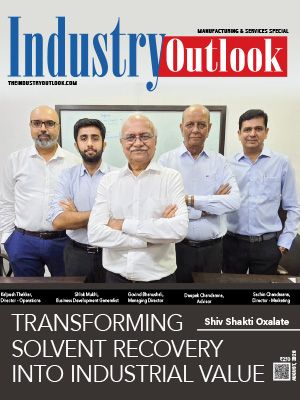
Few companies reflect this transition as clearly as Shiv Shakti Oxalate Pvt. Ltd. (SSOPL). Established in 2002, the company has evolved from manufacturing Di-Ethyl Oxalate and Oxalic Acid into one of India's advanced industrial solvent recycling and recovery specialists. Following a devastating plant accident in 2020, SSOPL rebuilt its operations from the ground up, commissioning a state-of-the-art facility at Kurkumbh MIDC, Pune. Today, with a processing capacity of 15,000 MT annually, the company is helping industries transform spent solvents into high-purity resources while advancing a more circular approach to industrial chemistry.
Reimagining Solvent Recovery
Founded in 2002, the company initially manufactured Di-Ethyl Oxalate and Oxalic Acid. Gradually, it diversified through toll manufacturing, product development, and solvent processing, steadily building expertise in handling complex chemical streams. The defining chapter arrived in October 2020, when a reverse surge current forced a complete shutdown of operations. Rather than restoring what had existed before, SSOPL chose to rethink its future.
Four years of engineering, planning, and investment culminated in a purpose-built solvent recycling and recovery facility spread across 13,000 square metres at Kurkumbh MIDC. Its core business today centres on recovering contaminated and spent industrial solvents, restoring them to high-purity, reuse-grade products that can re-enter manufacturing applications.
The company also undertakes contract manufacturing and specialized job work for multiple industries including but not limited to pharmaceuticals, automotive, paints, coatings, adhesives, inks, printing chemicals, and specialty manufacturing.
Central to this approach is SSOPL's Spent Purchase Model, where there is no obligation on the customer to re-purchase the goods and where the accountability and ownership fully transfers to SSOPL on receipt of the said goods for them to undertake the necessary recovery procedure(s).
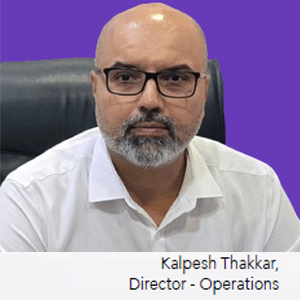
"The 2020 accident changed everything for us. We could have simply rebuilt what we had, but we chose to build something fundamentally better. Our vision evolved from manufacturing chemicals to regenerating resources, giving industrial raw materials a second life instead of allowing them to become waste”, speaks Kalpesh Thakkar.
Engineering Recovery with Scientific Precision
SSOPL's Kurkumbh facility has been engineered to address the inherent variability in solvent waste streams, where each stream exhibits distinct impurity profiles, contamination characteristics, and end-use specifications.
This prowess in advanced recovery is simply a byproduct of the emphasis the company has placed on infrastructure development, resource allocation, and process engineering.
The plant integrates six specialised distillation systems capable of atmospheric, fractional, vacuum, azeotropic, super-fractionating, multi-fractionating, and high-vacuum operations. Multi-stage vacuum systems operating at extremely low pressures enable thermally sensitive solvents to be recovered without degradation, while advanced cooling infrastructure supports uninterrupted processing under demanding industrial conditions.
Before commercial recovery begins, every solvent stream undergoes pilot-scale validation using dedicated glass assembly systems that determine the most efficient recovery route.
Supporting these operations is a sophisticated analytical laboratory equipped with Agilent Gas Chromatographs, Karl Fischer moisture analysers, ASTM distillation equipment, and comprehensive quality testing facilities.
Recovery efficiency extends beyond distillation. Plate Heat Exchangers and dedicated vent condensers capture volatile organic compounds that might otherwise be lost during processing, simultaneously improving solvent yield and reducing emissions. Complementing this is an effluent treatment system incorporating a pan-type evaporation unit, reinforcing the company's broader objective of minimising waste across both solvent and water management. This engineering philosophy is reflected in SSOPL's guiding principle - 'Precision in Recovery, Purpose in Every Drop’.
"Recovery isn't simply about distillation; it's about understanding every solvent stream and designing the right process for it. We invest heavily in technology because every improvement in recovery efficiency creates value for our customers while reducing the environmental footprint of industrial manufacturing”, shares Kalpesh Thakkar.
Circular Chemistry at Industrial Scale
Solvent recycling depends upon the fact that recovered material must consistently meet quality expectations, fit seamlessly into industrial processes, and create measurable environmental and economic value. SSOPL has built its operating model around achieving all three. Recovered solvents that meet top-of-the-line-grade specifications are returned to the manufacturing process. Rather than discarding material that falls short of those stringent requirements, the company reformulates it for alternative industrial applications.
The environmental impact is equally significant, reaching solvent recycling rates ranging from 30 percent to 90 percent, reducing hazardous waste disposal by as much as 70 percent while lowering dependence on virgin raw materials. Every processed batch is supported by detailed BMRs, enabling complete traceability while simplifying regulatory reporting for customers operating in highly regulated sectors.
Combined with SSOPL's MPCB authorisation, ISO 9001:2015 certification, structured Change Control procedures, and comprehensive SOPs, quality and compliance remain embedded throughout the recovery process rather than being treated as independent functions.
The company's integrated capabilities are reflected in projects undertaken for brands where recovered solvents have been successfully incorporated into printing chemical formulations, thinner formulations and more without compromising product performance. By reducing reliance on virgin raw materials while maintaining quality standards, SSOPL has helped customers strengthen procurement efficiency, improve sustainability performance, and build greater supply chain resilience.
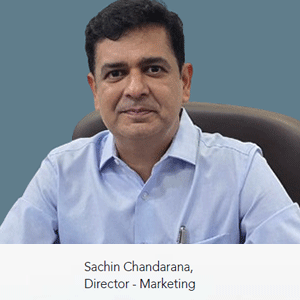
"Circularity only works when every recovered material continues to create value. If a solvent cannot return to its purest form, we engineer its next best use in another industry instead of discarding it. That philosophy ensures that virtually every recoverable fraction finds a productive second life”, mentions Sachin Chandarana.
Future Roadmap
Industrial solvent recovery is entering a new phase, shaped by increasingly stringent environmental regulations, stronger corporate sustainability commitments, and the emergence of measurable carbon accounting. SSOPL views these developments not simply as regulatory changes but as an opportunity to redefine the role of solvent recovery within industrial manufacturing.
The company is focused on scaling its Kurkumbh facility to its full annual capacity of 15,000 MT by adding two more distillation systems to the existing 6 while also expanding its footprint across pharmaceutical, specialty chemical, and manufacturing clusters. Simultaneously, it is strengthening its spent solvent procurement network through long-term partnerships, competitive procurement models, and dedicated collection programmes designed to improve both supply security and customer engagement. Combined with SSOPL's MPCB authorisation, ISO 9001:2015 certification, structured Change Control procedures, and comprehensive SOPs, quality and compliance remain embedded throughout the recovery process rather than being treated as independent functions
SSOPL is also progressing towards ISO 14001 and ISO 45001 certifications while aligning its operations with pharmaceutical-grade GMP requirements. Looking further ahead, the company is preparing for India's evolving carbon credit ecosystem by positioning solvent recovery as a measurable contributor to industrial decarbonisation. In the long term, SSOPL seeks to make responsible solvent management an integral part of industrial manufacturing.
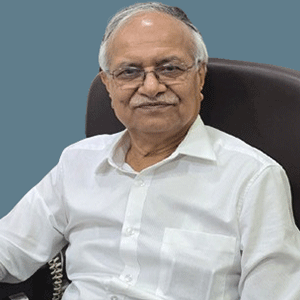
"Our ambition extends beyond expanding capacity. We want responsible solvent management to become the industrial default in India, where sustainability, compliance, and commercial performance reinforce one another rather than compete. That is the future we are building towards”, concludes Govind Bhanushali.
Building Circular Value Through Solvent Recovery
SSOPL has evolved from a specialty chemical manufacturer of Di-Ethyl Oxalate and Oxalic Acid into a process-driven leader in industrial solvent recovery and regeneration.
The company pioneered a Spent Purchase model that assumes complete ownership of solvent waste, simplifying compliance and disposal for customers.
Its recovery philosophy extends beyond conventional recycling, value maximization by engineering alternative industrial applications for recovered solvents that cannot return to its purest form.
SSOPL recovery solution is rigorously validated through pilot-scale trials prior to commercial deployment, improving recovery efficiency and product consistency.
The company is positioning solvent recovery as a quantifiable lever for industrial decarbonisation, with a forward-looking roadmap aligned to carbon credit frameworks and ESG-driven manufacturing practices.
We use cookies to ensure you get the best experience on our website. Read more...


