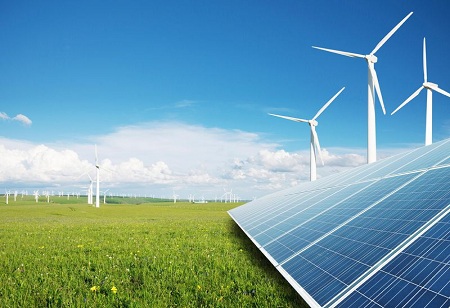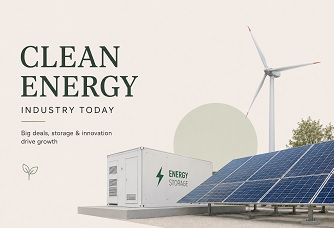
India’s clean energy sector is gaining momentum as companies, banks, and governments increase their focus on renewable power.
Major deals are bringing fresh investment into the sector, while banks are supporting large renewable projects with long-term funding. At the same time, rising renewable capacity is creating a greater need for battery storage across the country.
Smaller initiatives are also showing how clean energy can become part of everyday activities and tourism. From billion-rupee acquisitions to solar-powered boats, recent developments show India’s growing shift toward cleaner power. Together, these developments highlight both the opportunities and challenges facing the country’s energy transition.
Aditya Birla Group is in advanced talks with domestic banks to raise around INR 14,000 crore for its Sprng Energy acquisition. The group plans to use a long-term loan to help fund its purchase of Shell’s Indian renewable energy platform . Axis Bank has underwritten the entire proposed amount and may retain around INR 5,000 crore.
State Bank of India and HDFC Bank are considering commitments for the remaining amount. The group has also discussed the financing with several other domestic lenders. The proposed loan could have a repayment period of up to 20 years, with interest being discussed around 7.7 percent. The financing would be secured against Sprng Energy’s renewable power assets. The acquisition values Sprng Energy at around INR 17,200 crore and would add nearly 5 GWp of contracted renewable capacity.
Macquarie and RP Sanjiv Goenka Group have emerged as the final contenders to acquire Welspun New Energy. The renewable energy company’s sale has now entered its final stage, with negotiations underway with both bidders. The potential transaction could value the company at around INR 2,000 crore.
Welspun New Energy currently has around 45 MW of operating renewable capacity. Its biggest project under construction is a 245 MW wind-solar project in Gujarat. The company also has a much larger pipeline involving wind, solar, and energy storage projects. It is developing green hydrogen and ammonia projects as part of its longer-term plans. Welspun New Energy aims to reach 5 GW of renewable capacity by 2030. The company’s growing project pipeline makes the potential acquisition important for both bidders.
Also Read: How BESS Can Accelerate India’s Clean Energy Shift
India’s growing renewable power capacity is creating an urgent need for more energy storage systems. Experts say storage can help save electricity produced during sunny hours and supply it when solar power is unavailable. However, India currently has a major gap between its storage demand and domestic manufacturing capacity. Domestic battery manufacturing accounts for less than 1 percent of the estimated 260 GWh demand pipeline for 2026.
Industry members say India should not delay storage projects because some battery components still depend on imports. They believe storage is needed now to support the country’s expanding renewable power capacity. NTPC has already received approval for 5 GWh of battery storage under a government funding program. Research also suggests India could take more than a decade to become self-sufficient in battery storage.
Volks Energie CEO and Co-Founder Piyush Goyal said India's storage demand is running well ahead of what domestic cell manufacturing can supply, and that gap is a matter of years, not a few quarters.
Four boats at popular tourist destinations in Karnataka are now running on solar power. Two boats operate at Kudalasangama, while two others operate at Silver Lake in Almatti. The initiative aims to reduce fuel consumption, noise, and water pollution caused by conventional boats. The boats have been fitted with 18 solar panels, motors, and batteries at a cost of INR 44 lakh. The investment was voluntarily made by the contractor maintaining the boats.
Over the past four months, the boats have used only small amounts of diesel and electricity. The initiative also aims to introduce visitors to the benefits of solar energy. Local officials and visitors have welcomed the move, particularly because the boats produce less smoke. The project could encourage similar clean energy initiatives across Karnataka’s tourist waterways.
These developments show that India’s clean energy growth is happening across several areas at once. Large companies are investing in renewable businesses, while banks are providing funding for major projects. At the same time, rising renewable power is creating an urgent need for better storage solutions.
Smaller projects, such as solar-powered boats, are also bringing clean energy closer to everyday life. However, India will need stronger battery manufacturing and continued investment to maintain this momentum. As renewable projects expand, clean energy could play an increasingly important role in India’s economy, infrastructure, and daily life.
.jpg "Saksham Enterprises: Optimizing Mission- Critical HVAC Infrastructure For The High Precision Sector")

.jpg "JDS Group of Companies: Innovating Smart Solutions For Modern Power Transmission & Distribution Infrastructure")




We use cookies to ensure you get the best experience on our website. Read more...