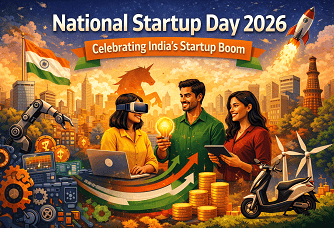
On the 16th of January, India does not just celebrate startups, but it celebrates the bravery to construct. National Startup Day 2026 reflects the extent to which the Indian startup ecosystem has already advanced, and the rate at which it continues to do so. Startups in India are transforming how the nation constructs, remunerates, educates, recuperates, and markets both in tiny co-working areas and over the world boardrooms.
There are more than 1.25 lakh startups in India today with more than 110 unicorns in fintech, SaaS, healthcare, climate tech and manufacturing. The startup boom in 2026 is no longer a mere hype. It is employment, exports, actual products consumed by millions.
What is unique about this moment is scale. Apps are not the only thing Indian entrepreneurs were creating. They are addressing profound issues, such as, access to credit, high-quality education, affordable healthcare, and clean energy. National Startup Day is a reminder that innovative startups have become a fundamental aspect of the way startups are influencing the Indian Economy.
Also Read: 8 Indian Startups CEOs Turning Local Factories into Global Brands
The last ten years transformed startups in India. In 2014, the ecosystem was young and uneven. India is now the third-largest startup hub globally. Major cities such as Bengaluru, Delhi-NCR, Mumbai, Hyderabad, Chennai, and Pune have been on the forefront, and Tier-2 cities such as Jaipur, Indore and Kochi are fast trailing.
Government support played a key role. Programs like Startup India, Digital India, and Atal Innovation Mission lowered entry barriers. Incubators, seed funding, and faster compliance gave founders room to experiment. Venture capital followed. So did global interest.
More importantly, startups began solving everyday problems. From digital payments in small towns to AI tools for doctors, startup growth India has been grounded in need, not noise. As Nandan Nilekani once said, “India’s startups are building public good at population scale.” That focus on scale and impact defines the Indian model.
Ritesh Agarwal CEO at OYO Rooms “Risking nothing achieves nothing. Entrepreneurship involves stepping out of your comfort zone, challenging convention and seeking the right opportunities.”
Startups are no longer limited to tech parks. They are reshaping core industries. Fintech changed how India pays and saves. Companies like Razorpay helped millions of small businesses accept digital payments. Today, Razorpay processes billions of dollars annually and supports MSMEs across India—proof of startup success stories India rooted in local needs.
In healthcare, Practo built a bridge between doctors and patients long before telemedicine became normal. During COVID, it scaled access fast. Even now, health-tech startups are using AI for diagnostics and IoT for remote care.
Education saw disruption through platforms like BYJU’S and newer emerging startups in India, focusing on skill-based learning and vernacular content. The shift is clear—learning is moving from degrees to outcomes.
Manufacturing and industrial tech are seeing quite a disruptive change. Ather Energy, an EV startup, combined hardware, software, and sustainability. Its success showed that deep-tech can thrive in India.
Across sectors, trends like AI, SaaS, IoT, and green tech dominate startup trends 2026. As Infosys co-founder Kris Gopalakrishnan noted, “The next wave of innovation will come from AI-driven startups solving real problems.”
“We believe startups are the heartbeat of innovation, driving change across industries and geographies. On National Startup Day, we celebrate the courage and vision of entrepreneurs who challenge norms and create solutions that impact millions," says Piyush Kedia, Co-Founder & CEO at InCommon.
“National Startup Day is a celebration of what makes India such an exciting place to build right now. The energy, ambition, and talent in this ecosystem are unlike anything I’ve seen before. We’re seeing startups go deeper by solving for real complexity, not just convenience. And what’s really promising is how tech and trust are starting to come together in meaningful ways." — Nitin Seth, Co-founder & CEO, Conversive
Also Read: India's EV Revolution: 5 Startups Disrupting the Auto Industry
The journey is not easy. Funding cycles are tighter. Scaling beyond India is hard. Talent shortages remain, especially in deep-tech and AI. Regulations can still slow growth.
Yet, opportunity outweighs risk. India’s digital base—UPI, Aadhaar, cloud adoption—gives startups a rare edge. Global markets now look to India not just for cost, but for ideas. Climate tech, agritech, and health-tech offer massive room to grow.
Peyush Bansal, founder of Lenskart, shared in a LinkedIn post, “Building in India teaches resilience. The market pushes you to think long-term.” That mindset is shaping a new generation of Indian entrepreneurs who think global from day one.
Akshay Shekhar, Co-Founder & CEO, Kazam, says, "India’s startup ecosystem is at a pivotal moment. As founders, we are not just building companies, we are building markets and helping India become globally competitive in sectors that are still taking shape.
National Startup Day is not just symbolic. It tells founders they matter. It tells students that entrepreneurship is a real path. It tells investors that innovation in startups is national business.
By celebrating startups publicly, India builds a culture that rewards risk, learning, and failure. It also strengthens India’s global image—not just as a service economy, but as a product and innovation leader. The India startup ecosystem now influences policy, exports, and global tech trends.
Startups are stories of belief. Belief that problems can be fixed. And those ideas can scale. That India can lead. On National Startup Day, support a startup. Work with one. Build one. The next big shift may not come from a giant—it may come from a small team with a bold idea.
Amit Jain Co-Founder &CEO at CarDekho, “When you are at the top of your game, all the chatter is around your success. What many don’t realize is the fact that it takes years of hard work and grit to build a business, and failing is a constant.”
What is National Startup Day in India?
National Startup Day, marked on January 16, celebrates India’s startup journey and recognizes entrepreneurs building new businesses and jobs.
Which sectors are leading India’s startup boom?
Fintech, healthtech, edtech, SaaS, e-commerce, and electric mobility are growing fast due to strong demand and digital use.
How are startups impacting India’s economy?
Startups are creating employment, supporting GDP growth, and solving everyday problems at scale across industries.
.jpg "Textile Special")






We use cookies to ensure you get the best experience on our website. Read more...