
India's renewable energy sector has reached a stage where adding generation capacity alone is no longer enough. The larger challenge is ensuring that clean power is available where and when it is required. Solar has led India's renewable expansion, but its generation profile, land requirements, grid constraints, and intermittency are driving greater interest in hybrid systems, storage, and decentralized generation.

This shift is already visible in the market: hybrid and battery storage projects accounted for more than 58 percent of renewable capacity auctioned in the first half of 2026, according to Mercom India.

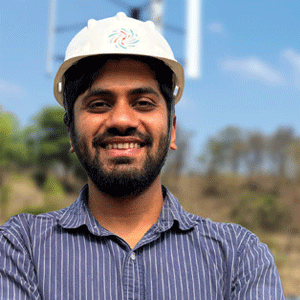
Within this evolving market, Apeiro Energy is addressing a segment that remains comparatively underdeveloped in India: distributed wind energy. Founded nearly five years ago by Kalpit Prajapati, Prakhar Yadav and Puru Kumar, the company is developing localized wind solutions through its iWind Vertical Axis Wind Turbines, designed to complement solar and battery storage rather than compete with them.
By integrating wind into decentralized renewable energy systems, Apeiro Energy aims to improve generation reliability while reducing dependence on a single energy source. Its approach is focused on making clean energy more reliable, affordable and accessible across industrial, commercial and community applications.
Addressing the Missing Piece in Distributed Renewables
India has built substantial capabilities in utility-scale wind, while distributed renewable adoption has been driven predominantly by solar. For Apeiro Energy, this creates an important market gap. Local wind resources, particularly at sites with favourable wind conditions, remain significantly underutilized despite their potential to generate power during hours when solar availability declines.
This complementarity is central to the company's market approach. Solar performs strongly during daylight hours but declines in the evening and can be affected during the monsoon. Battery storage can bridge part of this gap, but relying entirely on storage for extended non-solar periods can influence project economics. Apeiro therefore sees distributed wind, solar, and battery storage working together as a more balanced energy architecture.
“The company develops 'iWind vertical axis wind turbines' suited to localized conditions and integrates them with solar and battery energy storage systems for on-grid and off-grid applications. By bringing generation closer to consumption, the model can also help reduce dependence on long-distance transmission for specific applications, particularly in remote and decentralized settings”, highlights Kalpit Prajapati, Co-Founder and CEO.
Apeiro's journey has gained international validation along the way. The company has won the Avenia Energy Startup Challenge and the New Generating Startup Award at COP28 by IRENA. It was also selected among startups for the Catalyst Program by Masdar City and BP Ventures and was among two Indian startups selected for the Clinton Global Initiative Greenhouse Cohort in 2024.
Building Solutions Around Real Market Requirements
One of the challenges Apeiro encountered early was the absence of a mature domestic component ecosystem for distributed wind. Generators, control systems, inverters, and microgrid integration technologies often had to be sourced internationally, creating trade-offs between cost and reliability. The company responded by developing much of its technology stack in-house.
Technology, however, is positioned as an enabler of commercial viability rather than an end in itself. Apeiro uses Computational Fluid Dynamics to develop turbine blades for low-speed and turbulent wind environments and has created an AI-powered micrositing platform to determine whether a particular location can generate sufficient wind energy before deployment.
“The platform combines satellite, field, airport, terrain, and geospatial data to improve site selection and energy-output estimation. This becomes particularly important because wind is hyperlocal. A commercially viable distributed wind project depends not simply on installing a turbine, but on matching the technology with the right location, load profile, and complementary energy sources”, adds Puru Kumar, Co-Founder.
The company's deployments illustrate this application-led approach. In Maharashtra, Apeiro installed a 10 kW wind-solar hybrid system for a village that faced daily grid downtime and prolonged disconnection during the monsoon. The system continued supplying electricity even when flooding isolated the village.
In Bhavnagar, Gujarat, Apeiro has deployed a 10 kW pilot at a saltworks facility, where pumps operate for extended hours during the production season. The system generates around 70–75 units per day, with scope to scale the deployment to 200 kW. Coastal saltworks represent a particularly relevant market because their continuous pumping requirements coincide with favourable wind conditions. Apeiro Energy is developing next-gen vertical axis wind turbines hybridizing utility-scale wind and solar farms
Same Land, More Megawatts
Having spent its initial years building and validating its technology, Apeiro Energy is now moving deeper into commercialization. A major growth opportunity lies in existing solar farms, where the company is working with organizations including Tata Power, GMR, and Jakson on integrating distributed wind turbines into available spaces within operating projects.
According to Apeiro, around 15–20 percent of space in certain solar farms can potentially be utilized for wind installations. Its proposed model can increase installed capacity by approximately 25 percent without requiring additional land, while using existing transmission and distribution infrastructure.
This offers developers a way to improve asset utilization while creating a more diversified generation profile. "International markets form the other pillar of Apeiro's roadmap. The company is exploring opportunities in the UAE and Africa through partnerships, including discussions with UAE-based Enerwhere”, adds Prakhar Yadav, Co-Founder.
For Apeiro, recognition among leading Renewable Energy Solution providers comes at an important transition from R&D to wider commercialization. Beyond visibility, it strengthens the credibility required to engage customers, partners, and investors in an emerging category. As India's renewable market increasingly moves toward hybrid, decentralized, and demand-aligned energy systems, Apeiro Energy aims to establish distributed wind as a meaningful part of that mix - turning an underutilized resource into a scalable contributor to energy resilience and independence.






We use cookies to ensure you get the best experience on our website. Read more...