For decades, buying an industrial robot meant buying a machine. Today, the more valuable purchase is the intelligence inside it.
According to Polaris Market Research, the AI-powered industrial robot market was worth USD 7.97 billion in 2025 and should reach USD 22.72 billion by 2034, a 12.3 percent CAGR.
The headline figure matters less than what is driving it.
Robots are becoming platforms that learn, update and earn recurring revenue, and executives who still evaluate them as equipment risk misjudging both cost and competitive risk.
Conventional robots excel at repetition. A car-body weld line performs the same motion millions of times, and learning adds little there.
AI changes the economics where variety rules: mixed parts, short batches and frequent product changes. A vision-guided, AI-enabled cell can adapt to new parts in minutes or hours, where reprogramming a conventional robot can take days.
Three forces are pushing adoption. Labor shortages make repetitive factory work hard to staff. Electronics and AI-server investment is lifting orders, and FANUC's first-quarter orders in 2026 jumped 36.9 percent year on year.
Meanwhile, simulation tools let manufacturers train robots in virtual plants before installing them. The strategic point is that flexibility, not raw speed, is what buyers are now paying for.
Also Read: Green Energy Corridor Phase 3: Who Funds Rs 1.86 Lakh Cr?
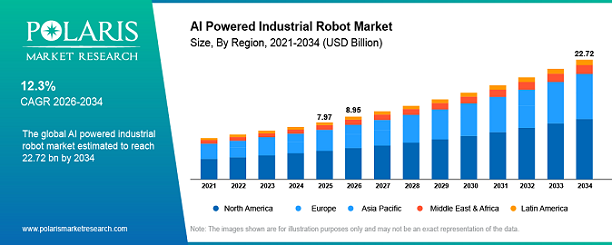
Hardware still dominates today, at roughly 62 percent of 2026 component revenue, because every deployment starts with an arm and a controller. But software is the fastest-growing component, at a projected 21.5 CAGR through 2034.
The reason is structural. Each installed robot can pull through licenses, simulation tools, model updates and fleet management for years, a recurring stream hardware alone cannot match.
Robot foundation models sharpen this trend. Skild AI's near-USD 1.4 billion raise at a valuation above USD 14 billion shows investors expect one model to control many robot bodies. For manufacturers, that opens a retrofit path: upgrading existing robots with AI controllers rather than replacing them.
In the Middle East, Saudi Arabia leads at a 20.0 percent CAGR as Gulf nations diversify their industrial bases.
The market splits into established robot makers, AI specialists and chip providers. FANUC, ABB Robotics, YASKAWA and KUKA are all embedding NVIDIA's simulation and edge-computing tools, with an installed base of more than 2 million robots among them.
Startups sell either foundation models or AI-native arms, while NVIDIA supplies the computing underneath.
Ownership is also shifting. SoftBank agreed to buy ABB Robotics for USD 5.375 billion, framing physical AI as its next frontier, yet China blocked the transfer of the China business in November 2026.
For buyers signing long-term contracts, the lesson is practical: ask how ownership changes could affect support.
Incumbents keep one durable advantage. Plants rarely switch robot brands after a line passes safety audit, so proven reliability, service networks and certifications are hard to displace. Supplier concentration in reducers, servo motors and AI chips adds another pressure point.
Also Read: How CNG, Hybrids & EVs Will Take 41.95% Share as India Moves Beyond Petrol Cars?
Expect four developments:
Healthcare and pharmaceuticals (22.7 percent CAGR) and food and beverage (17.3 percent) look like the next frontiers, alongside natural-language programming, the fastest-growing AI technology at 21.9 percent.
The AI-powered industrial robots market is growing at a healthy pace, but the more important story is where value is moving. Hardware earns the entry ticket, while software, services and open platforms capture the long-term returns.
Manufacturers should buy for adaptability and ecosystem openness, and suppliers should compete on intelligence and lifecycle value. The winners through 2034 will not be those who build the strongest arm, but those who make every arm smarter over time.







We use cookies to ensure you get the best experience on our website. Read more...